

"It is a well-known fact, and undoubtedly has been for a long time, that a room, a carriage, a bed, are heated more strongly by the sun when its rays pass through glass or closed frames than when these same rays enter the same places open and without glazing. It is even known that the heat is greater in rooms where the windows have double frames."
/image%2F0561035%2F20230907%2Fob_36e4e9_heliometre-saussure-02.png)
This is how Horace Bénédict de Saussure began a letter, dated April 17, 1784, addressed from Geneva to the "Journal de Paris". A geologist and naturalist born in Conches near Geneva in 1740, Saussure is best known for his excursions in the Alps and in particular for being one of the first to reach the summit of Mont Blanc where he was able to observe that the boiling point of water was only 86° on our Celsius scale.
Heat is also one of his primary interests. That's why this phenomenon of rising temperature behind a window could not fail to attract his attention.
"When I first reflected on these well-known facts, I was very surprised that no physicist had sought to see how far this increase or concentration of heat could go," he wrote.
Horace Bénédict de Saussure, the heliothermometer and the greenhouse effect.
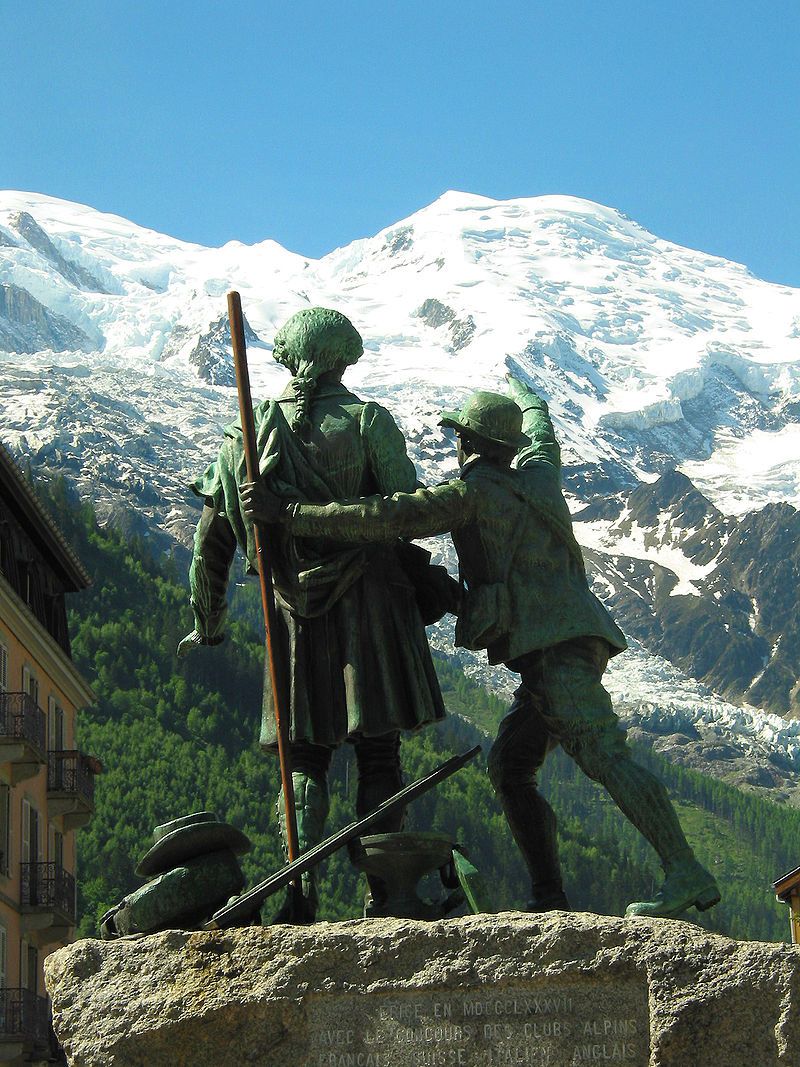
He therefore set out to report on a series of measurements he had begun in 1767. His experimental device, which he named the Heliothermometer, was a "fir box one foot long by 9 inches wide and deep." Previous studies had shown him that a dark body absorbs heat better, so he chose to line the inside of the box "with a layer of black cork one inch thick," which also provided good thermal insulation. Its lid consisted of three panes of glass "placed one and a half inches apart." The experiment required tracking the sun's path so that its rays always entered the box perpendicularly to the glass. Using this method, the highest temperature reached was 87.7°, "that is to say, more than 8 degrees above the temperature of boiling water." The scale used here is Réaumur's, which sets the boiling point of water at 80 degrees. By taking measures to better insulate the box, he even obtained temperatures reaching 128°R, or 160°C.
That's all for the observation.

"As for the theory," he wrote, "it seems so simple to me that I don't believe it will add much to the glory of whoever develops it." He recalled that "the immortal Newton" had proven that bodies are heated by the light they absorb. The explanation therefore seemed obvious to him:
"Without deciding whether the sun's rays are themselves fire, or whether they only impart to the fire contained in bodies a degree of movement which produces heat, it is a fact that they warm them. It is an equally certain fact that when the body on which they act is exposed to the open air, the heat with which they penetrate it is partly stolen from it by the currents that reign in the air, and by those that this heat itself produces. But if this body is situated so as to receive its rays without being accessible to the air, it retains a greater proportion of the heat that is imparted to it."
Meteorology today measures the importance of convection phenomena for heat exchange in fluids, particularly in the atmosphere and oceans. Saussure had already analyzed them effectively, observing that in a closed, insulated glass box, the air retained its heat because there could be no exchange with the colder outside air. The potential applications of his experimental setup were also well conceived.
"As for applications, I also considered them," he wrote. "Since I did not flatter myself that I could melt metals, I only thought of using this invention for purposes requiring only a little more heat than boiling water. I also wanted to avoid the constraints and wasted time involved in constantly exposing the container to the sun as its position changed. With this in mind, I tried using hemispherical glass caps that fit one inside the other."
The idea was justified, the approach demonstrated genuine scientific rigor. Alas, the expected result was not achieved, and the experimenter observed that "one could not even boast of cooking soup in this device." He therefore preferred to stick with his original box, which, in addition to serving as a "solar thermometer," would be suitable, he said, for distillations or any other operation that did not require "a degree of heat much higher than that of boiling water." Could he have imagined that two and a half centuries later, such boxes, with a larger surface area and a blackened base pierced by coils carrying a heat transfer fluid, would be placed on the roofs of houses to provide their occupants with the hot water necessary for their domestic use? His device, which had highlighted what we now call the "greenhouse effect," has indeed become, through the use of solar thermal panels, an economical, intelligent, and non-polluting use of solar radiation.
Jean Baptiste Joseph Fourier. From the heliothermometer to the temperature of the Earth.
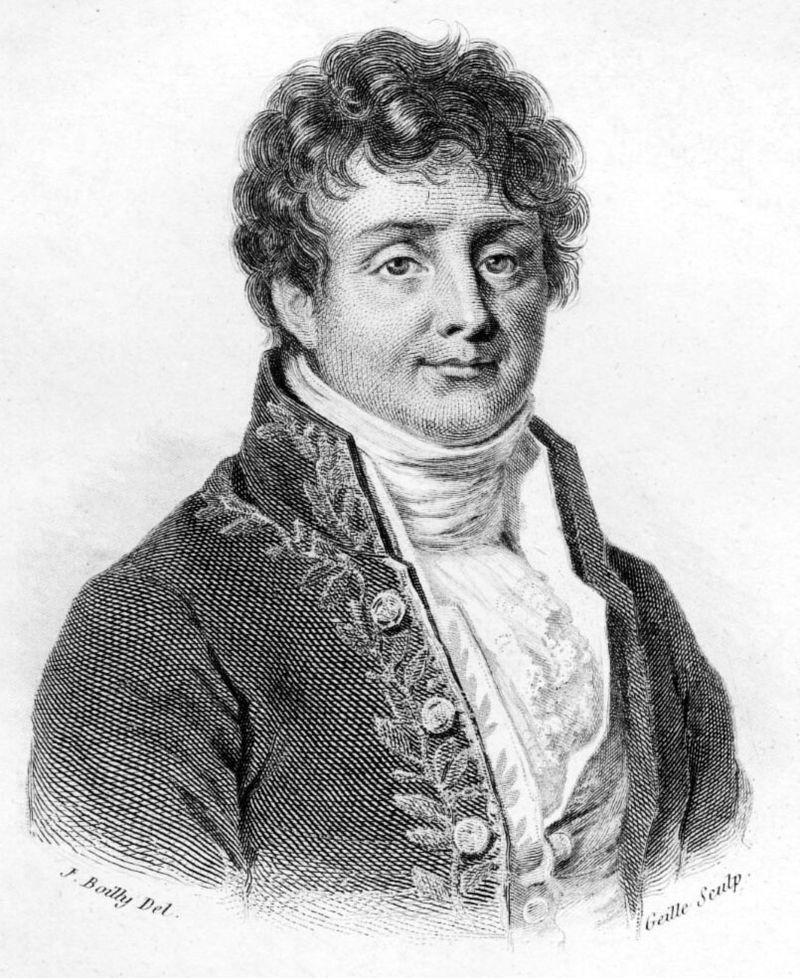
Fourier (1768-1830) is primarily known as a mathematician for his "series," a mathematical tool he initially applied to the study of heat diffusion. In 1827, his "Memoir on the Temperatures of the Earth and Planetary Spaces" was published in the Mémoires de l'Académie des Sciences de l'Institut de France. Inquiring into the influence of the atmosphere on the Earth's temperature, he makes a strong reference to the work of Saussure. "We owe," he says, "to the famous traveler an experiment that appears very well suited to clarifying the question." He precisely describes the instrument developed by Saussure. He was particularly interested in it because it allowed its inventor to "compare the solar effect on a very high mountain to that occurring on a lower plain," thus demonstrating the role of atmospheric thickness in the phenomenon.
"The theory behind this instrument is easy to grasp," he said. Like Saussure, he believed "that the heat acquired is concentrated because it is not immediately dissipated by the renewal of the air." He added a second reason that brings us closer to a widely held contemporary view:
"The heat emanating from the sun has different properties from dark heat. The rays of this star are transmitted to a fairly large extent beyond the glass in all the containers and to the bottom of the box. They heat the air and the walls that contain it: then the heat thus communicated ceases to be luminous; it retains only the common properties of dark radiant heat. In this state, it cannot freely pass through the glass plates that cover the vessel; it accumulates more and more in a container enveloped in a very poor conductive material, and the temperature rises until the incoming heat is exactly compensated by that which dissipates."
About ten years separate this text from Fresnel's presentation of his wave theory of light. This "dark radiant heat" would have to wait a few more years before being termed "infrared radiation".
The analogy with the atmosphere then became obvious to Fourier. The same phenomenon would explain the higher temperature in the lower layers of the atmosphere. If the different layers of the atmosphere remained motionless, they would behave like panes of glass. "Heat arriving in the form of light at the solid earth would suddenly and almost entirely lose its ability to pass through transparent solids; it would accumulate in the lower layers of the atmosphere, which would thus acquire high temperatures." Fourier was not unaware, however, that hot air rises and mixes with the cold air at higher altitudes, but he believed that this phenomenon should not completely alter the effect of dark light "because heat encounters fewer obstacles to penetrating the air, being in the form of light, than it encounters to pass back into the air when it is converted into dark heat."
Since Lavoisier we have known that air is a mixture of gases, so what does the permeability of air to solar radiation or to "dark radiant heat" mean? Do the different gases that compose it all have the same behavior? This is the question that John Tyndall asks.
John Tyndall (1820-1893), the discoverer of "greenhouse" gases.
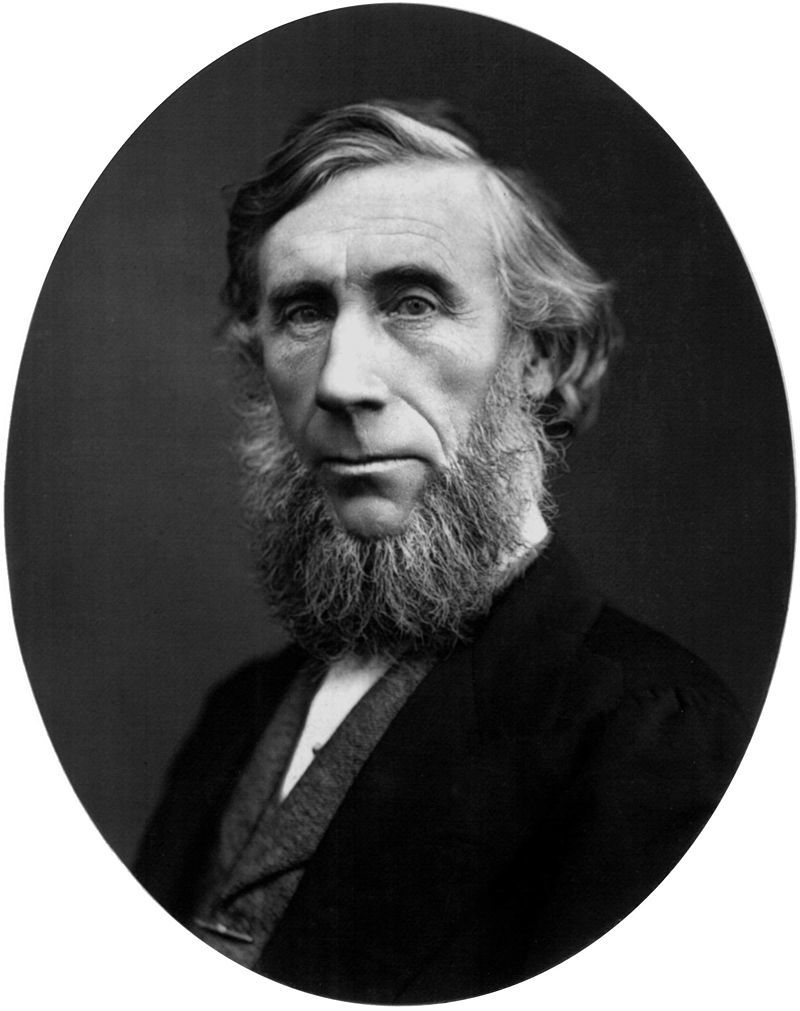
John Tyndall was born and raised in Ireland. A self-taught man, like Faraday, whose student he was, his scientific work earned him a solid reputation, both in Europe and in the United States. An excellent popularizer, he gave a lecture in Cambridge in 1864 entitled "Radiation," in which he presented his work on the absorption of light rays by various gases. His translation by Abbé Moigno was published in France the following year. His translator was enthusiastic: "The subject of his dissertation was dictated by the immense impact of his remarkable discoveries in the field of light and heat radiation. He treated it with masterful clarity, conciseness, elegance, and ease; and we cannot recall having read any other scientific dissertation with greater pleasure."
The text is short (64 pages) and the praise is justified. It deserves to be read in its entirety. Anyone who reads it will find the essence of what climatologists teach us today. His exposition focuses first on establishing the existence of light invisible to the naked eye. It has been accepted since Fresnel that sunlight is composed of multiple radiations. In particular, he is interested in what he calls "ultra-red," which we now refer to as "infrared." He explains how its existence was revealed by the British astronomer William Herschel. The experiment is remarkable and deserves to be remembered.
It deserves to be read in its entirety. Anyone who reads it will find the essence of what climatologists teach us today. His exposition focuses first on establishing the existence of light invisible to the naked eye. It has been accepted since Fresnel that sunlight is composed of multiple radiations. In particular, he is interested in what he calls "ultra-red," which we now refer to as "infrared." He explains how its existence was revealed by the British astronomer William Herschel. The experiment is remarkable and deserves to be remembered.
Referring to the work of Ritter and Stokes on "ultraviolet", Tyndall was then able to present solar radiation as composed of "three different series".
-Ultra-red rays possess a very high heat output, but are incapable of stimulating vision.
-Light rays that display the following sequence of colors: red, orange, yellow, green, blue, indigo, violet.
-Ultraviolet rays, like red rays, are unsuitable for vision. Their heat output is very low, but due to their chemical energy, they play a crucial role in the organic world.
This is followed by a discussion on the nature of radiation. What is the link between the heat released in a platinum wire heated to red or white by an electric current passing through it and the perception of this light by the eye? His compatriot Maxwell recently hypothesized that light is an electromagnetic wave traveling through a hypothetical ether. His answer is consistent with the model. He says there exists a "luminous ether" which, like air transmitting sound, is "capable of transmitting the vibrations of light and heat." Thus, "each collision of each atom in our wire excites a wave in this ether which propagates within it at a speed of 300,000 kilometers per second." It is this wave, received by the retina, that causes our sensation of light.
The following chapter is entitled "Absorption of radiant heat by gases". Its subject matter is particularly relevant to our topic, namely what we refer to as the "greenhouse effect".
"First limiting our research to the phenomenon of absorption, we must imagine a succession of waves originating from a source of radiation and passing through a gas. Some of these waves collide with gas molecules and impart their motion to them; others glide around the molecules, or pass through their intermolecular spaces, without any perceptible obstacle. The problem consists of determining whether such free molecules have, to any degree, the power to stop the heat waves, and whether the different molecules possess this power to different degrees."
The experimental setup consists of a copper plate heated until incandescent. The light produced is transmitted to a tube sealed by two rock salt plates, "the only solid substance that offers an almost imperceptible obstacle to the passage of heat waves." The tube can be filled with various gases under the same pressure of 1/30 of an atmosphere. The temperature inside is measured by a thermoelectric pile, a recently invented instrument.
/image%2F0561035%2F20231123%2Fob_b33e75_effet-de-serre-absortion-gaz.JPG)
The results are published in a table which expresses the quantities of radiation absorbed respectively by the different gases, "taking as the unit the quantity absorbed by the atmospheric air".
It contains most of the gases whose harmful effects concern us today. In particular, carbon dioxide (carbonic acid), nitrous oxide, and nitrous acid.
One last, "incredible" result!
A final section completes this picture. It concerns the study of "aqueous vapors in the atmosphere in their relationship to terrestrial temperatures." The significance of the results warrants a more detailed presentation. After the initial measurements carried out on various gases, "we are now prepared to accept a result that, without these preliminary steps, would have seemed completely unbelievable," the speaker announced.
The new gas being studied is none other than water vapor. It is "a perfectly impalpable gas, diffused throughout the atmosphere even on the clearest days." The quantity of this vapor is infinitesimal compared to the oxygen and nitrogen composition of the air. Yet measurements show that its effect is 200 times greater than that of the air containing it. This fact, he notes, "has the most serious consequences for life on our planet."
The most serious consequences? That's exactly what most of our contemporaries would be tempted to say, but John Tyndall actually saw it as an opportunity. The heat from the ground, warmed by the sun's rays, is transmitted to the atmosphere in the form of these "ultra-red" light waves of great calorific power. Air alone would be insufficient to retain them. Fortunately, Tyndall observes, "the water vapors slow the movement of the ethereal waves, heat up, and thus surround the earth like a mantle, protecting it from the deadly cold it would otherwise have to endure."
Later, in his conclusion, the observation takes on lyrical proportions. "A spider's web stretched over a flower is enough to protect it from the night frost; similarly, the water vapor in our air, however attenuated, stops the flow of heat radiated by the earth and protects the surface of our planet from the cooling it would inevitably undergo if no substance were interposed between it and the void of celestial space." He offers as proof that wherever the air is dry (deserts, high mountain peaks), this results in extreme daytime temperatures. Conversely, "during the night, the earth radiates heat unimpeded towards its celestial realms, resulting in a very low minimum temperature."
The discovery is significant, and he claims it as his own. While acknowledging that his predecessors—de Saussure, Fourier, Pouillet, and Hopkins—had "enriched the scientific literature" on this subject, he observes that it is not air itself, as they did, that should be the focus of study, but rather the water vapor it contains..
It should be noted here that, although he cites Saussure, the effect he describes has nothing to do with that of a greenhouse in which air heated by the sun is confined. It is therefore erroneously that the expression "greenhouse effect" continues to fuel our contemporary debates. Where does the expression come from? It is found used by Arrhenius, whose contribution we will see shortly. "Fourier," he writes, "the great French physicist, already admitted (around 1800) that our atmosphere exerts a powerful protective effect against heat loss by radiation. His ideas were later developed by Pouillet and Tyndall. Their theory is called the 'hot greenhouse theory' (emphasis added), because these physicists observed that our atmosphere plays the same role as the glazing of a greenhouse." Although the term used by the scientific community is "radiative forcing", the scorching image of a greenhouse is so much more evocative that its success is assured for a long time to come.
So, the Earth is protected by water vapor? We are in the early stages of Europe's industrial development; how could Tyndall have imagined that this balance, which had lasted for thousands of years, would be disrupted in the coming century? Not primarily by water vapor, but by CO2. What does he say about this gas? He has already measured that its absorption of light rays is nearly 1,000 times greater than that of air. He also observes that there are a number of rays "for which carbonic acid is impenetrable." He even uses it as a means of measuring the CO2 level in exhaled air. But he will not perceive its crucial role in the warming of the atmosphere. That will be the contribution of Svante Arrhenius.
Svante Arrhenius.

Svante Arrhenius was born in Vik, Sweden, in 1859. A chemist and Nobel laureate, he is known to aspiring chemists for the law concerning the rates of chemical reactions that bears his name. Meteorologists primarily remember his studies on the absorption of infrared light by water vapor and CO2. His article "On the Influence of Carbonic Acid in the Air on the Temperature at Ground Level," published in 1896, was a standard reference for many years. Although his calculations were later challenged, his analysis led some commentators to call Arrhenius "the father of climate change."
Using measurements of lunar radiation made by Frank Washington Very and Samuel Pierpont Langley, he deduced the percentage of CO2 absorbed by our atmosphere. He then realized that the rapid increase in coal consumption could contribute to increasing this amount. "Carbonic acid," he wrote, "forms such a small fraction of the atmosphere that even industrial coal consumption seems to have an effect on it. Annual coal consumption reached 1,200 million tons in 1907 and is increasing rapidly." He noted that its increase was steady: 510 million tons in 1890, 550 million tons in 1894, 690 million in 1899, and 890 million in 1904, and he therefore concluded that "the amount released into the atmosphere can be modified, over the course of centuries, by industrial production."
The combustion of this coal increases the CO2 level in the atmosphere, and he estimated that if this level were to double, the Earth's temperature could rise by around 4°C.
This level was then around 300 ppm (300 parts per million), and he did not foresee this doubling for another 3,000 years, which was the time he estimated would be needed to exhaust most of the subsoil's coal resources. A century later, this level has already exceeded 400 ppm. Without being overly pessimistic, the IPCC scientists estimate that this 4°C temperature increase could be reached by the end of this century and warn us of all the upheavals that await us!
Arrhenius, for his part, is not worried. If he thinks about future generations, it is by considering that this temperature increase could have a beneficial aspect for them. He states this without hesitation in a work published in 1907 in which he presents his vision of the appearance and evolution of life on Earth under the title "Worlds in the Making; the Evolution of the Universe," translated in France as "L'évolution des mondes" (The Evolution of Worlds).
"We often hear," he writes, "lamentations about the fact that the coal stored in the earth is wasted by the present generation without any thought for the future… We can find some consolation in the consideration that here, as often, there is a benefit on one side for a harm on the other. Through the influence of the increasing percentage of carbonic acid in the atmosphere, we can hope to enjoy a better and more equitable climate in the future, especially with regard to the colder regions of the earth. In the future, the earth will produce far more abundant crops than at present, to the benefit of the rapid growth of humanity."
It took less than a century for this dream of a bright future, at least for the inhabitants of the northern hemisphere, to turn into a nightmare for the entire planet Earth.


/image%2F0561035%2F20140324%2Fob_6b7b8e_003-vinci-dodecaedre-02.jpg)