Overblog Tous les blogs Top blogs Technologie & Science Tous les blogs Technologie & Science
Suivre ce blog Administration + Créer mon blog
MENU
26 janvier 2021 2 26 /01 /janvier /2021 17:26

Fragment du journal Journal de Sébastien le Braz, chirurgien de marine, à Brest, au temps de la guerre d'indépendance américaine.


28 juin 1778.


La guerre est là. A peine revenu de l'hôpital du Folgoat où j'ai soigné les blessés de la Belle-Poule, un ordre vient de m'être porté m'enjoignant de rejoindre le bord du Saint-Esprit.


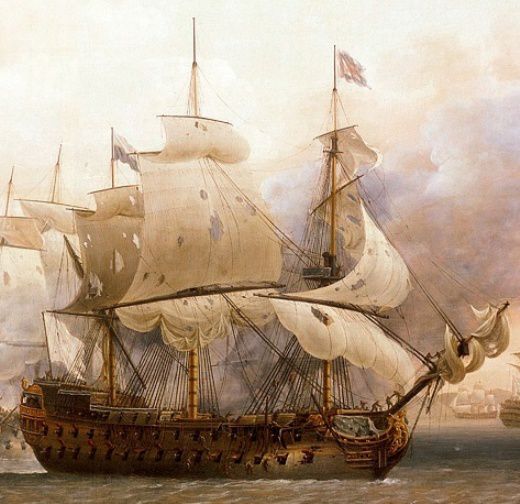
Je connais ce bâtiment sur lequel j'ai déjà embarqué pour des manoeuvres dans la rade de Brest. C'est un 80 canons qui a la réputation d'être solide et bon marcheur. Il compte déjà une vingtaine d'années de service mais demeure l'un des meilleurs de la flotte. J'y serai l'adjoint du chirurgien-major Billard.


Le Saint-Esprit au combat.


Familier des routes de l'Afrique et des Antilles, le Saint-Esprit a été construit pour opérer pendant des semaines, loin de ses bases sans toucher terre. Pour nourrir les 900 membres de l'équipage et des troupes de marine embarquées, il peut emporter pour trois mois de consommation d’eau, six mois de vin, cinq à six mois de vivres, soit plusieurs dizaines de tonnes de biscuits, farine, légumes secs et frais, viande et poisson salé, fromage, huile, vinaigre, sel, sans compter le bétail sur pied qui est abattu au fur et à mesure de la campagne. 


Toute cette capacité ne peut que rassurer un officier de santé, à condition d'être bien gérée. Mon oncle Mazéas m'a fait cadeau de "l'essai sur les moyens les plus propres à conserver la santé des gens de mer" qu'il a traduit de l'anglais James Lind, membre du collège royal des médecins d'Edimbourg.  Comment ne pas partager l'ambition de l'auteur qui note que "conserver la santé des gens de mer, c'est entretenir la force, l'activité, le courage, qualités si nécessaires au service du Roi. En effet, il n'y a point d'entreprises difficiles ou dangereuses aux yeux d'un équipage qui jouit d'une parfaite santé ; les plus grands obstacles s'évanouissent alors."  J'ai, hélas, pu constater que notre marine a bien des progrès à faire si elle veut rivaliser, sur le sujet de l'hygiène, avec la flotte britannique. 


Le Saint-Esprit est commandé par La Motte-Piquet dont la légende alimente, depuis longtemps déjà, les chroniques brestoises mais aussi celles des rives de la Tamise où sa réputation de redoutable adversaire n'est plus à faire. Il n'est pas un officier ou un matelot qui ne souhaite servir sous ses ordres.


J'ai fait mes adieux au Chevalier de Boufflers. Il espérait voir des détachements de son régiment embarqués sur l'un des vaisseaux de l'escadre où serait affecté le duc de Chartres mais il n'en est rien. Il croit savoir que le roi lui même s'y est opposé, celui-ci ayant déjà retardé sa promotion au grade de colonel sous le prétexte, lui a-t-on rapporté, qu'il "n'aime ni les épigrammes ni les vers". "Je suis fou d'aimer la gloire, elle ne veut pas de moi" m'a-t-il confié en me quittant. Il en était d'autant plus affecté qu'il croyait savoir, malgré le secret entourant sa venue, que le Duc serait embarqué sur le Saint-Esprit et que j'aurais ainsi, à nouveau, l'occasion de le croiser après notre escapade aux mines de Poullaouen.


 7 juillet.


Je suis à bord du Saint-Esprit depuis le 29 juin. J'ai pris possession de mon infirmerie. Assez vaste, bien abritée au centre du vaisseau. Le coffre aux remèdes est abondamment pourvu. La présence du Duc à bord y est certainement pour beaucoup. J'ai visité les réserves. A l'évidence nous ne sommes pas partis pour une longue croisière. Le Chevalier avait vu juste, il n'était pas question de débarquer sur le sol anglais.


Je n'ai pas manqué d'ouvrage depuis mon arrivée. Comme trop souvent une partie de l'équipage est constituée de malheureux récemment raflés sur les quais et d'autres sortis des prisons. Certains souffrent de fièvres, d'autres présentent des plaies qu'il faut soigner au plus vite. Ils tremblent de froid dans des vêtements souvent en loques et déjà imprégnés de l'eau de mer. Plusieurs se sont déjà blessés dans des manoeuvres qu'ils découvrent à peine. L'infirmerie est leur refuge.


Des marins aguerris passent parfois sous le prétexte d'une blessure légère et plus surement pour voir qui les soignera si le besoin s'en fait sentir. Ma réputation m'a suivie depuis l'affaire de la Belle Poule et ils semblent rassurés. Ils nous donnent des nouvelles du pont. La présence du Duc ne les rassure pas. Ils connaissent leurs officiers et leur font confiance, mais que vient faire à leur bord ce commandant sans expérience de la guerre et encore moins de la mer. Qu'avaient à faire sur ce navire les cuisiniers, valets d'office, rôtisseurs et sommeliers qu'il avait embarqués avec lui*.


Etant monté sur le pont pour prendre l'air il m'est arrivé d'y croiser le Duc de Chartres entouré de sa Cour. J'ai eu la surprise d'observer, à une distance respectueuse du Duc, le personnage rencontré à Poullaouen lors de la visite de la mine de plomb argentifère. Le bref regard qu'il ma lancé a semblé indiquer que je luis rappelais moi-même quelque chose. Il était alors vêtu d'un costume civil. Je le retrouve ici sous l'uniforme d'officier.

Il est manifestement attentif à ce qui se dit autour de lui. Je me souviens qu'il semblait parfaitement comprendre le parler breton que pratiquent beaucoup de nos marins. Rien de ce qu'ils croient échanger dans le secret de leur langue ne lui échappe. Cette campagne s'entoure de mystère.


Nous appareillons dès demain.


Voir la suite : 

Sébastien le Braz. Après la bataille de Ouessant.


notes

https://www.histoire-genealogie.com/Les-chirurgiens-navigants-sur-les-navires-du-roi

* Merci à Jean-François Parot historien méticuleux et magnifique narrateur et à son commissaire Le Floch (Le noyer du grand canal)

Partager cet article
Repost0
24 janvier 2021 7 24 /01 /janvier /2021 15:52
Gérard Borvon

In the year 1746, everything seems to have been said on the subject of electricity and the interest of the "Philosophers of Nature" goes towards other curiosities. It was then that M. de Réaumur, a member of the Académie des Sciences, received a letter from his Dutch correspondent, Pierre Van Musschenbroek, which again boiled scientific Europe.


In a few decades, a new science was born:

Electricity.


It began with his baptism by Gilbert, his popularization by Otto de Guericke and Hauksbee, his entry into the academic world with Gray and Dufay.


A man, in this new period, rises to the rank of the first of the "electrifying". He is a skillful experimenter: the abbot Nollet.


L'abbé Nollet


While his predecessors were still rubbing simple glass tubes or sticks of sulfur or resin, he built impressive machines with flywheel and gear drive. In numerous and abundantly illustrated books, he makes known his experiences, he describes his devices. The number of editions reflects the interest generated. In Paris, in the provinces, abroad, new arrangements are implemented by following its directives or by renewing already older experiments.
 
 
In this year 1746, however, everything seems to have been said on the subject and the interest of the "Philosophers of Nature" goes towards other curiosities. It was then that M. de Réaumur, a member of the Académie des Sciences, received a letter from his Dutch correspondent, Pierre Van Musschenbroek, which again boiled scientific Europe.


Terrible news from Leiden

Pierre Van Musschenbroek (1692-1761) is professor of physics at Leiden and author of widely translated works. One day in 1746, one of his collaborators, M. Cunéus, was busy "electrifying" the water contained in a bottle. He holds it with one hand, a conductor connected to an electric machine is immersed in it. The method, as we will see, is unusual.


Musschenbroek

It is when he deems the bottle sufficiently charged that he has a painful surprise. He brings his free hand closer to the conductor immersed in the bottle. At the same moment his hand is struck by a noisy spark, his body writhes in a spasm of extraordinary violence. An unbearable pain overcomes him. Pierre Van Musschenbroek and his colleague Allamand, informed of the miracle, verify the phenomenon. It is Musschenbroeck who informs learned circles of all the capitals of Europe.


L’expérience de la Bouteille de Leyde (Les Merveilles de la science)


His letter will be read on April 20 in Paris during a session of the Academy of Sciences and commented on by Abbé Nollet:


"I want to communicate to you a new but terrible experiment which I advise you not to attempt yourself... I had suspended from two silken threads an iron cannon, AB, which received by communication the electricity of the glass globe, which was rapidly rotating on its axis, while it was rubbed by applying the hands to it; at the other end B hung freely a brass wire, the end of which was plunged into a round glass vase D, partly filled of water which I held in my right hand F, and with the other hand E, I tried to shoot sparks from the electrified cannon: suddenly my right hand F was struck with such violence that I had the body shaken as from a thunderbolt; the vessel, though of fine glass, does not usually break, and the hand is not injured by this shock, but the arm and the whole body are affected by a terrible way that I cannot express: in a word, I believed that it was the end of me”.


Another letter from Leyden confirms this testimony. It is from M. Allamand.


“You must have heard of a new experience that we have done here (the description of the experience follows)... You will feel a prodigious blow which will strike your whole arm, and even your whole body, it is a thunderbolt; the first time I tried it, I was so dazed that I lost my breath for a few moments: two days later, M. Musschenbroek having tried it with a hollow glass ball, he was so deeply affected that a few hours later, having come to my house, he was still moved by it, and told me that nothing in the world would be able to make him try the thing again."


The abbe Nollet, who knows the seriousness of his interlocutors, approaches this new experience with a certain apprehension. The result confirms his apprehension.


"I felt in my chest and in my bowels, a shock that made me involuntarily bend my body and open my mouth".


Terrible ! Such is the phenomenon. Gradually, however, it is domesticated and the primitive terror fades. Electricity then descends into the streets, or rather into the gardens and parks, where, as Abbé Nollet notes, it “shows itself to the people”.


We were not without noticing that two people holding hands simultaneously receive the electric shock when, one carrying the bottle, the second touches the conductor connected to the machine. Two people, then three... the chain gets longer.


Nollet is not the last to engage in these “media” demonstrations. He imagines unloading a bottle of Leyden through the chain formed by three hundred soldiers of the French guards holding hands. The people should not have been indifferent to the spectacle of these “guardians of order” shaken by the electric shock. Better: monks forming a conductive chain around their abbey will prove, by jumping in the air all together under the effect of the electric discharge, that it propagates at an extraordinary speed. At least this is how rumor translated a wiser experiment carried out by Lemonnier in the Carthusian convent.


Everyone strives to offer a different scenario: a doctor uses the Tuileries basin to transmit electricity. A certain prince, at the end of an opera performance, applauds a demonstration of electric shock presented on stage by the actors.


We also exchange recipes. Abbot Nollet offers several:


"Try the Leiden experiment with a porcelain coffee cup, with a rock crystal bottle, if you can get one, or with one of those little brown pots in which butter from Brittany is sent to Paris and to that of Normandy; and that will succeed for you.


The Leyden bottle is therefore the first “electric capacitor”. It may seem surprising that such a spectacular observation was only made so late.


The fault perhaps lies with Dufay. Having been one of the first to electrify the liquid contained in a bottle, he had inaugurated a strict method, often referred to as "Dufay's rule". The electrical fluid must not be able to escape from the bottle. For this, the vase containing the liquid had to be made of thick glass and, above all, placed on a perfectly insulating support! An academic electrician would never have deviated from the rule. It therefore took a poorly informed experimenter to break with this tradition. This poor manipulator was however going to provoke, without having sought it, a revolution.


How does this bottle work?


Musschenbroek, the first, admits his ignorance: he no longer understands anything, he says, and can no longer explain anything about electrical phenomena. A bottle held in the hand should never have been able to be charged, especially if it was made of thin glass. The electrical fluid had to pass through the thin thickness of glass to flow without difficulty towards the earth through the body of the operator. Yet it was this ridiculous assembly, this manipulation outside of all the rules, which had caused the most violent phenomena ever observed.


Better ! The more the glass is thin, the more violent the shaking. The more contact with the ground is ensured, for example by covering the external part of the bottle with a sheet of metal, the greater the efficiency will be. Everything seems to work opposite to what is expected. Those who attempt an explanation quickly give up: the Leyden bottle remains an exception. We'll use it but we'll forgo finding out more for now. Once again, it will take an observer without academic training to overcome the obstacle. It will be Franklin once again.


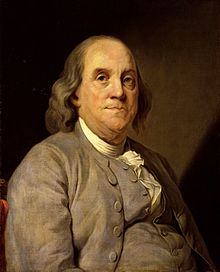
Franklin


It should be remembered that Franklin imagines a unique electrical fluid which permeates all bodies and which can simply be accumulated or rarefied by means of devices acting as "pumps". It is again this model which allows him to interpret the functioning of the Leyden bottle in a truly convincing manner. The wire connected to the machine and dipping into the liquid in the bottle pushes back, he says, an excess of electrical fluid into it. At the same time, the same quantity of this fluid is repelled through the glass and expelled, from the external metal frame then from the hand of the observer who carries it, towards the earth.


In reality, as Franklin said, the bottle is not really "charged" with electricity because, "whatever quantity of electric fire passes through the top, an equal quantity comes out through the bottom." The phenomenon stops when it is no longer possible to get more electricity into the bottle, that is to say when "it can no longer be extracted from the lower part". When this moment arrives, a strong positive charge has accumulated in the bottle while an equivalent lack has been created in the external armature.


From then on, the “electric shock” is clearly explained. By connecting the internal and external parts of the bottle by a conductive body, balance is suddenly restored. If this conductor is a small diameter metal wire, it can become incandescent or even melt. If it is a person, they will experience a shock that they will not soon forget. If it is a small animal, it could lose its life.


Franklin's interpretation aroused the enthusiasm of many supporters among those who had been left thirsty by the mystery of the Leyden bottle. This will also irritate many. Nollet, for example, cannot give up losing its place as “first” European electrician. A controversy arose between him and Franklin over the question in which part of the bottle the electricity accumulated.


Nollet believes that it is the water in the bottle which concentrates the electricity and he proves it: a bottle full of water being charged with electricity, pour this water into another bottle placed next to it on a pedestal table. You will find that this second bottle is quite capable of giving you an electric shock. The electricity was therefore transmitted with the water in the bottle.


Franklin asserts on the contrary that it is in the glass that this accumulation is located and he also proves it: a bottle full of water being charged with electricity, pour this water into another bottle placed next to it on a table, as Father Nollet recommends. You will notice that this second bottle is completely incapable of giving the slightest electric shock. On the other hand, the first bottle, although empty, retained all its potency. This can easily be seen by refilling it with uncharged water. The electric charge was therefore well preserved in the glass.


Two opposing observations for two absolutely identical experiments? One clarification, however: the pedestal table on which Abbé Nollet places his second bottle is made of a conductive metal, contrary to the rule published by Dufay. Franklin's is covered with a very dry plate of glass, which does not correspond to the standards of the Leiden experiment!


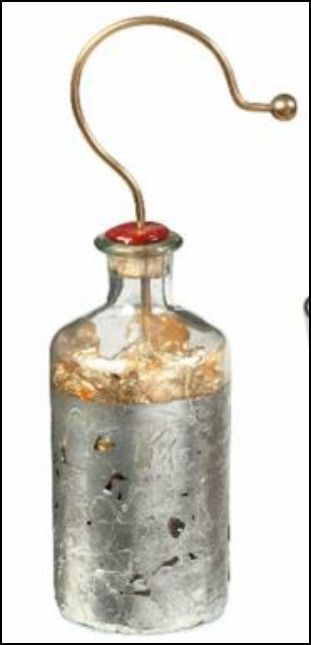
We leave it to the informed reader to decide between these two doctors. We will simply observe that Franklin, emphasizing that water plays no role in this matter, does not need a container to contain it. He will therefore use, instead of bottles, glass tiles placed between two lead blades of slightly smaller size. A layout close to that of our current capacitors. Nollet, for his part, popularized the traditional bottle, easy to bild and simple to use. However, he will replace the water with lead shot, iron filings or better, crumpled gold leaf. In this form, the Leyden bottles, often combined in batteries, will spread to the most unexpected places. For example in the doctor's office.

Une bouteille miracle.

collection Jean-Jacques Kress


Very early on, the therapeutic effect of this miracle bottle was envisaged. One had barely had time to ascertain some of the properties of electricity when a whole world of healers lacking respectability or doctors waiting for clients had already seized it. Already yellow amber, then called succin, was a traditional element of the pharmacopoeia, it was therefore logical that we seek to use its essential "principle", the electric fluid, this vital fluid which already allowed Thales to “give life to inanimate beings”.


To Give life or take it: Bose killed flies by striking them with the spark flying from his outstretched finger. Nollet kills sparrows by using a Leyden bottle. Franklin kills a turkey by discharging an entire "battery" of loaded bottles through the poor animal.


Take life or give it back: a previously drowned sparrow is brought back to life by the discharge of a bottle. A hen is resurrected by the same means. The Leyden bottle really works miracles.


It is easy to imagine the benefits that could be gained by skillful manipulators from these machines capable of extracting "fires" and other "effluvia" from this or that diseased organ of their patient. Collecting the entire medical “bloopers” of the 18th century would require several volumes. Father Berthollon, a famous and often translated popularizer, sees electricity as a real panacea: it makes you lose weight, it even makes your hair grow back! It is possible to give vigor to indolent natures by administering positive electricity to them and naturally to calm the nervous with negative electricity. Electricity promotes flow: electrifying the patient during bleeding gives a jet of blood that is “lively, dilated and extending far away”. Mr. Jallabert, professor of "Experimental Philosophy" is categorical, no one can question the results obtained on his patients "and if some doctors have seen contrary examples, I suspect that fear or someone other particular obstacle , will influence the experience".


A fear certainly justified and which could only grow from the moment the Leyden bottle came to strengthen the healer's arsenal. Father Nollet was the first to try to apply electric shocks to a paralytic. Judicious approach when we notice the involuntary contractions thus caused. The beginnings seem encouraging: under the effect of the shock the patient sees muscles that have been inert for a long time contract. But autonomous motor skills do not return and we must give up. However, some cases of cure are announced, many paralytics voluntarily expose themselves to electric shock. One increase the capacity of the Leyden bottles, one combine them into batteries and, soon, one are very close to killing our patient because they are no longer pleasant sparks coming out of these devices.


Mr. Jallabert, for example, wants to reinforce the effect of the shock by using hot water. One day he uses boiling water:


"I substituted boiling water for hot water. Very bright flashes appeared of their own accord before you put your hand near the vase: they become even brighter and more numerous when you put your hand on them. at the moment when the person, who touched it with one hand, with the other drew a spark from the bar, the fire with which the vase was filled suddenly appeared with inexpressible vivacity. At the same moment an orbicular piece of the vase of 2 lines and half diameter was thrown against the wall which was five feet away...
The astonishing vivacity of a fire which cannot be better compared to that of lightning; this incredible phenomenon of a vase pierced by the action of electricity, the terrible shock felt by the one who pulled the spark: all this had impressed on the spectators a terror which did not allow me to expose any from them to a second torture.


...a fire that one cannot better compare to that of lightning...


Already, in his first letter the image had been used by Musschenbroek: "my whole body shook as if by a thunderbolt...". Is it just an image or is there really an identity between lightning and electric discharge? The idea has been in the air for several years. Father Nollet had already suggested it. It is surprising to note that the years go by without any European scientist really seeking to explore this analogy further. It will take an American "amateur", Franklin again, to shake up old Europe and revive interest in electrical science.


Partager cet article
Repost0
26 décembre 2020 6 26 /12 /décembre /2020 12:49


Lorsque l’on visite le magnifique musée de l’électricité qui a été aménagé dans la propriété qu’André-Marie Ampère possédait à Poleymieux -aux pieds des Monts d’Or et à quelques lieues de Lyon - on remarque, dans la salle consacrée à l’illustre savant et à sa famille, une plaque sur laquelle figure la mention suivante :
« Le jeune André-Marie AMPERE n’est jamais allé à l’école : guidé par son père, il s’est instruit lui-même à Poleymieux ».

Pour en juger, le mieux est de parcourir l'autobiographie de Ampère publiée sur le site Ampère/CNRS.
 

André-Marie Ampère naquit à Lyon le 20 janvier 1775 de Jean-Jacques Ampère, négociant, et de 
Jeanne-Antoinette de Sutières-Sarcey. Son père qui n'avait jamais cessé de cultiver la 
littérature latine et française, ainsi que plusieurs branches des sciences, l'éleva lui-même 
dans une campagne voisine de la ville où il était né. Jamais il n'exigea de lui d'étudier quoi 
que ce soit, mais il sut lui inspirer un grand désir de savoir. Avant de pouvoir lire, le plus 
grand plaisir du jeune Ampère était d'entendre des morceaux de l'Histoire naturelle de Buffon, il 
demandait sans cesse qu'on lui lût l'Histoire des animaux et des oiseaux dont il avait appris 
depuis longtemps tous les noms en s'amusant à en regarder les figures. La liberté qu'on lui 
laissait de n'étudier que quand il lui plaisait de le faire fut cause que, quoiqu'il sût épeler 
depuis longtemps, il ne lisait point encore, et c'est en s'exerçant seul à comprendre l'Histoire 
des oiseaux qu'il apprit enfin à lire couramment. Bientôt la lecture des livres d'histoire et des pièces de théâtre qu'il trouvait dans la bibliothèque de son père l'attacha autant que 
celle de Buffon. Il se passionnait pour les Athéniens et les Carthaginois et prenait en haine les 
Lacédémoniens et les Romains, quand il les voyait subjuguer ou détruire les peuples qu'il 
affectionnait. Il prenait un singulier plaisir à apprendre des scènes entières des tragédies de 
Racine et de Voltaire et à les réciter en se promenant seul. Les sentiments que ces lectures 
développaient en lui s'exaltaient par ce qu'il entendait raconter des évènements de la guerre que 
l'Angleterre et la France se faisaient alors au sujet de l'indépendance des États-Unis. 

Son père qui connaissait et parlait même la langue de Virgile aussi bien que l'aurait pu faire le 
plus habile professeur lui inspira le désir de l'apprendre en lui récitant souvent des vers de cet admirable poète, dont 
l'harmonie charmait le jeune Ampère. Il sut bientôt assez de latin pour comprendre les auteurs qui 
ne présentent pas de grandes difficultés ; mais à treize ans, les Éléments de mathématiques de 
Rivard et de Mazéas étant tombés sous sa main, toute autre étude fut oubliée (2). Il s'en 
occupa uniquement, et la lecture de ces deux livres fut suivie de celle de l'algèbre de Clairaut et 
des traités des sections coniques de La Chapelle et du Marquis de L'Hôpital (3). Ne connaissant 
personne qui eut la moindre connaissance des mathématiques, il se mit à composer un traité des 
sections coniques avec les matériaux qu'il trouvait dans ces ouvrages et des démonstrations qu'il 
imaginait et croyait nouvelles. Mais quand il voulut lire les articles de mathématiques de 
l'Encyclopédie, il fut arrêté par l'emploi du calcul infinitésimal dont il n'avait aucune idée.
 

Ayant à cette époque, pendant un séjour de quelques mois que son père fit à Lyon, eu 
l'occasion de voir M. Daburon, alors professeur de théologie au Collège de la Trinité de Lyon, 
aujourd'hui inspecteur général des études, qui s'était beaucoup occupé de mathématiques, il 
lui raconta l'embarras où le mettaient les d qu'il trouvait dans ces articles sans qu'on y eut dit 
ce que cette lettre représentait. M. Daburon fut frappé de ce que le jeune Ampère avait fait sans 
autre secours que les livres qu'il avait étudiés. Il eut la bonté de lui donner quelques leçons 
de calcul différentiel et de calcul intégral et lui aplanit ainsi les difficultés qui l'avaient 
arrêté. Son père, pénétré de reconnaissance, se lia d'une intime amitié avec M. Daburon qui 
venait parfois passer quelques jours à la campagne où il avait ramené son fils. M. Daburon 
dirigea les études mathématiques du jeune Ampère et lui inspira une nouvelle émulation qui 
rendit ses progrès plus rapides. 

Chaque année, M. Ampère passait deux mois à Lyon ; il conduisit son fils à quelques leçons du 
cours de physique de Monsieur le Professeur Mollet (4). De retour à la campagne, celui-ci lut quelques 
ouvrages de physique, et quelque temps après, la lecture des Lettres de Rousseau sur la botanique 
lui ayant inspiré une grande ardeur pour l'étude de cette science, il partagea son temps entre les 
herborisations et les calculs. 

Cependant, les troubles politiques amenaient en France des évènements aussi désastreux 
qu'inattendus ; la guerre civile éclata, et Lyon fut assiégé par l'armée de la Convention. M. 
Ampère laissa sa famille à la campagne et se fit un devoir de ne pas abandonner ses concitoyens. 
Il refusa de sortir de la ville assiégée et lorsqu'elle succomba, il fut une de premières 
victimes du tribunal révolutionnaire.

Voir la suite  sur le site Ampère CNRS.

Partager cet article
Repost0
12 décembre 2020 6 12 /12 /décembre /2020 13:35

Le 23 novembre 2020, a eu lieu une journée d’hommage national à André-Marie Ampère, placée sous le haut patronage de Madame Frédérique Vidal, Ministre de l’Enseignement supérieur, de la recherche et de l’innovation et avec le soutien de ce Ministère.

voir : https://oxi99.com/FXJIDEC30/4F1DA2FAE9F44C9BB91EB03865B6533B.php


Ressources documentaire :


https://ampere2020.fr/ressources-documentaires-et-pedagogiques/le-monde-de-lelectricite/

  • BELTRAN, Alain. La fée électricité, Paris : Découvertes Gallimard, 1991.
  • BLONDEL, Christine. Histoire de l’électricité, Paris : Pocket, 1994.
  • BORVON, Gérard. Histoire de l’électricité, de l’ambre à l’électron, Paris :Vuibert, 2009. Consultable sur overblog
  • FARA, Patricia. An Entertainment for Angels. Electricity in the Enlightenment, Cambridge: Icon Books, 2002.
  • MORUS, Iwan Rhys. Michael Faraday and the Electrical Century, Cambridge: Icon Books, 2004.
  • Thomas Edison, Les Cahiers de Science & Vie, avril 1996, n°32.
  • Benjamin Franklin : comment réussit-il à vaincre la foudre ?, Les Cahiers de Science & Vie, août 1995, n° 28.
  • Revue générale de l’électricité, numéro spécial intitulé : « Ampère, André Marie. » n°6 novembre 1922. Consultable sur Gallica:
Partager cet article
Repost0
7 décembre 2020 1 07 /12 /décembre /2020 15:58
Partager cet article
Repost0
7 décembre 2020 1 07 /12 /décembre /2020 10:17

Revue La Nature.

L'article ci-dessus a été cité par un des intervenants aux colloques sur Edmond Becquerel du 7 décembre 2020.

A suivre une intervention sur un pionnier qui rappellera un ancien slogan "faites du solaire, pas du nucléaire"


voir la vidéo : https://youtu.be/qicmiJv3iVs?list=PL5UqkzFNKba-2yAtWSsilXzEiIuFPk36A

L'article ci-dessus a été cité par un des intervenants aux colloques sur Edmond Becquerel du 7 décembre 2020.

A suivre une intervention sur un pionnier qui rappellera un ancien slogan "faites du solaire, pas du nucléaire"


voir la vidéo : https://youtu.be/qicmiJv3iVs?list=PL5UqkzFNKba-2yAtWSsilXzEiIuFPk36A

Partager cet article
Repost0
23 novembre 2020 1 23 /11 /novembre /2020 14:14

https://www.arte.tv/fr/videos/093803-001-F/desobeissant-e-s/


Face à l'urgence climatique, une frange importante de la jeunesse a fait le choix de la désobéissance civile et de l'action. Le passionnant récit, en immersion, d'une mobilisation sans précédent.


Après un été 2018 marqué par la canicule, les incendies et la démission fracassante de Nicolas Hulot, un groupe de jeunes gens, affolés par l'inaction des gouvernements face à la crise climatique, décide d'unir ses forces. Un QG, La Base, est loué en plein Paris. En germe depuis la COP21, une internationale informelle du climat relie différents mouvements de contestation européens : Extinction Rebellion, Ende Gelände, Alternatiba, ANV-COP21… Parmi eux, des jeunes de moins de 30 ans. Certains, comme Élodie et Pauline, ont lâché un poste prestigieux pour se consacrer à un combat qu'ils jugent crucial. Après une première victoire – la pétition baptisée "L'Affaire du siècle" et ses 2 millions de signatures en quinze jours –, les activistes de La Base organisent 134 décrochages de portraits d'Emmanuel Macron dans les mairies, retransmis sur les réseaux sociaux, afin de dénoncer "le vide de sa politique écologique". C’est leur première grande action de désobéissance civile. Le documentaire suit ces "désobéissants" en action et dans l’intimité : des "gilets jaunes" à la pandémie de Covid-19, l’année 2020 va les mettre à l’épreuve.


Sentiment d'urgence 


Alizée Chiappini et Adèle Flaux captent l'émergence d'une génération qui, à sa façon pragmatique, ouverte et combative, imagine un nouvel engagement citoyen. Fonctionnant en réseau, les militants de La Base n'hésitent pas à traverser la Manche pour prendre des leçons de non-violence chez les cousins britanniques ou à se rapprocher des "gilets jaunes" pour rassembler les luttes sociales et environnementales. Ponctué de moments forts, comme le blocage de La Défense, "la république des pollueurs", face à des cadres ulcérés ou approbateurs, ce récit limpide, parcouru par un sentiment d'urgence, fait vivre de l'intérieur un an et demi d'une mobilisation sans précédent, combat qui vaudra à ses "meneurs", arrestations, gazages et poursuites juridiques. Ce document passionnant tient à la fois du manuel politique et du roman initiatique, l'aventure passant par différentes phases quand l'enthousiasme fait place à la désillusion avant de retrouver un nouveau souffle.

Partager cet article
Repost0
18 novembre 2020 3 18 /11 /novembre /2020 16:10

A l'occasion du bicentenaire de la naissance de Edmond Becquerel, un colloque lui est consacré.

Edmond Becquerel : une passion pour la lumière
Conférences en ligne, le 7 décembre 2020

On peut lire aussi l'article de Christine Blondel, historienne de l'électricité, consacré à ce savant.

BECQUEREL, Edmond (1820-1891). Professeur de Physique appliquée aux arts (1852-1891).

Extrait :

Une dynastie scientifique Les dynasties scientifiques ne sont pas rares au XIXe siècle. (Alexandre-) Edmond Becquerel appartient à la plus célèbre d'entre elles en physique. Son père Antoine-César Becquerel (1788-1878), lui-même, son fils Henri Becquerel (1852-1908), auteur de la découverte de la radioactivité, et enfin son petit-fils Jean Becquerel (1878-1953) se succédèrent en effet de père en fils à la chaire de physique appliquée du Muséum d'histoire naturelle, partageant les mêmes domaines d'intérêt, tous quatre ayant par ailleurs été admis à l'École polytech¬ nique. A la section de physique de l'Académie des sciences, où il est élu en 1863, Edmond Becquerel siégea une quinzaine d'années aux côtés de son père et, à la fin de sa vie, quelques années aux côtés de son fils. Les quatre générations de Bec¬ querel partagèrent dans le cadre du Muséum d'histoire naturelle la même maison, le même jardin, le même laboratoire. Si, pour un chroniqueur de la fin du XIXe siècle, il s'agit d'une des dynasties dans lesquelles « le talent et le savoir se trans¬ mettent comme par héritage a1, sans doute faut-il y voir davantage un trait du fonctionnement des institutions scientifiques parisiennes au XIXe siècle.

A suivre


Partager cet article
Repost0
2 novembre 2020 1 02 /11 /novembre /2020 12:48

10 contre arguments:

« Alors que les énergies fossiles sont devenues plus chères que la plupart des sources renouvelables et qu’elles sont responsables d’une grande partie de la pollution mondiale et des perturbations climatiques, certaines voix continuent à nier la nécessité d’une révolution énergétique et s’en prennent au solaire » constate Bertrand Piccard. À l’origine de Solar Impulse, premier avion zéro-carburant, l’explorateur juge « primordial de tordre le cou à quelques idées reçues. »


Solar Impulse, le premier avion zéro-carburant à l’autonomie perpétuelle. | REUTERS ARCHIVES


« L’électricité produite à partir du solaire coûte trop cher »

Commençons par l’argument le plus courant : c’est trop cher. C’était vrai autrefois, mais ça ne l’est plus. D’après un rapport d’IRENA, le coût de l’électricité photovoltaïque a baissé de 82 % depuis 2010, et cette tendance va s’intensifier dans le futur. L’année dernière, un record a été établi par l’entreprise française Akuo Energy (dont plusieurs technologies sont labellisées par la Fondation Solar Impulse) lors d’un appel d’offres du gouvernement portugais. Une centrale de 150 MW fournira de l’électricité solaire à un prix record de 1,5 centime / kWh. Dans de nombreux endroits du monde, le solaire est devenu la source d’énergie la plus compétitive, devant les énergies fossiles polluantes, et bien souvent devant le nucléaire.


C’est vrai qu’elles sont intermittentes. Le soleil ne nous éclaire pas la nuit, et pas tous les jours. Mais face à ce sujet, qui est d’ailleurs fondamental dans la transition écologique, de nombreuses technologies deviennent disponibles afin de stocker l’énergie produite. L’hydrogène est en une, tout comme les batteries au lithium, notamment celles des véhicules électriques lorsqu’ils ne roulent pas, l’air comprimé ou les stations de transfert d’énergie par pompage (STEP). D’autres moyens innovants existent, tels que les briques de céramique recyclées qui stockent la chaleur à des températures comprises entre 500 et 1 000 °C, ou encore Energy Vault, qui a développé une grue de 120 mètres de haut, qui hisse des blocs de béton lorsqu’il y a trop d’électricité et les laissent redescendre en générant de l’électricité lorsqu’on en a besoin.


C’est clair que le coût du stockage doit être intégré dans le prix final de l’électricité solaire, mais même ainsi, le photovoltaïque reste compétitif, tant ces technologies ont évolué.


« C’est une menace pour le monde industriel et financier traditionnel »

Ce n’est vrai que si les dinosaures s’arcboutent sur le passé. C’est pour cela qu’il faut encourager les compagnies pétrolières à prendre dès maintenant le virage écologique et à se renommer compagnies énergétiques. La diversification des majors dans la production et la distribution d’énergies renouvelables ne peut que leur être bénéfique. Sans même parler du service aux consommateurs, qui devient une source importante de revenus comme Engie le démontre chaque jour. Cet été, malgré la publication de l’un de ses pires résultats trimestriels, l’action BP a clôturé en hausse de 6,5 % après l’annonce de leur stratégie environnementale, qui annonçait une multiplication par dix de ses investissements dans les renouvelables et une neutralité carbone en 2050 ! Pourquoi ? Parce que les fonds de pension et assurances-vie savent pertinemment que les investissements dans les énergies fossiles deviennent des actifs pourris, comme les subprimes en 2008…


« Le changement climatique est un problème à très long terme »

J’entends parfois certains dire que les énergies solaires sont avant tout un moyen de lutter contre les changements climatiques, qui est un problème à long terme – quand ils ne nient pas tout simplement l’existence de cette crise – et que nous avons d’autres priorités immédiates. C’est doublement inexact. D’abord parce que les conséquences du changement climatique se font déjà ressentir partout dans le monde. Mais aussi, et surtout, parce que l’énergie solaire permet de lutter contre un autre problème catastrophique et très actuel : la pollution de l’air. D’après l’Organisation Mondiale de la Santé, ce fléau touche 9 personnes sur 10 dans le monde et tue approximativement 8 millions de personnes chaque année à cause des maladies qu’elle engendre.


« Il n’y a pas suffisamment de soleil partout »

Mais là où il n’y a pas de soleil, il peut y avoir du vent, des cours d’eau, des vagues, de la géothermie… Le solaire n’est pas la panacée et doit être combiné avec d’autres sources complémentaires. Il n’y a pas une solution unique pour répondre à ce problème, mais une combinaison de technologies propres.


« Ça ne suffira pas à garantir les besoins en électricité du monde entier »

Au rythme du gaspillage actuel dans le monde, c’est vrai : environ 75 % de l’énergie produite est perdue en raison des technologies archaïques qui sont toujours en service. C’est pourquoi je me bats depuis de nombreuses années pour que l’efficience énergétique soit une priorité de l’agenda environnemental. Nous devons mettre en place des normes et réglementations beaucoup plus strictes dans ce domaine afin que nos appareils électriques, bâtiments, transports et usines soient plus efficients en énergie.


« Les panneaux solaires nécessitent trop d’énergie pour leur fabrication »

J’ai vu récemment un « expert » annoncer à une commission parlementaire qu’un panneau solaire met 30 ans à rembourser son énergie grise, c’est-à-dire l’énergie nécessaire à sa fabrication, son transport, son recyclage, etc. Or ce chiffre est totalement faux. Dans la moitié du monde, comprenant une grande partie de la France, ce chiffre se situe entre 6 mois et un an. C’est-à-dire qu’en moins de 12 mois, un panneau solaire a remboursé l’électricité qu’il a nécessitée pour sa fabrication.


Durant les 30 années suivantes de son exploitation, il produit une électricité décarbonée et inépuisable.


« C’est une énergie pour pays riches »

Totalement faux. Comme c’est la façon de produire l’électricité la meilleure du marché, l’énergie solaire, puisqu’elle est décentralisée, en permet l’accès aux populations les plus isolées et défavorisées. Tant de pays pauvres s’appauvrissent encore davantage chaque année en dépensant leurs devises pour acheter du gaz ou du pétrole, sans avoir les moyens de tirer des lignes à haute tension, que l’énergie solaire devient la seule façon d’assurer un développement économique local et une stabilité sociale.


« Le solaire nécessite des subventions publiques »

Si son développement a effectivement démarré par une garantie de rachat de l’électricité solaire à des prix souvent élevés, c’est l’inverse qui se produit aujourd’hui un peu partout : les énergies fossiles sont subventionnées à hauteur de milliards de dollars dans le monde et ne couvrent en rien leurs externalités, c’est-à-dire les dégâts sanitaires et environnementaux qu’elles causent.


« Ce n’est pas beau »

Dites plutôt : ce n’était pas beau. Aujourd’hui, les tuiles solaires, comme celles du pavillon français de l’Exposition universelle de Dubaï, permettent de s’adapter à tous les contextes.


Vous l’aurez compris, je suis un fervent défenseur de l’énergie solaire. Non pas parce qu’elle m’a permis de voler nuit et jour à bord de Solar Impulse, ni même parce qu’elle permet de lutter contre les changements climatiques. Mais parce qu’elle est une alternative logique, avant même d’être écologique qui crée des emplois durables et produit une électricité moins chère que les énergies fossiles. Les demi-experts ne pourront pas l’empêcher de devenir une source d’énergie majeure dans le monde, à condition que l’on se protège de leurs contre-vérités.

Partager cet article
Repost0
20 octobre 2020 2 20 /10 /octobre /2020 12:54

Two kinds of electricity or just one? We have seen that until the end of the 19th century two systems coexisted.


That initiated by Dufay of the two types of electricity: vitrious or positive, resinous or negative.


Franklin's one : a single kind of electricity charging bodies more or less.


It is true that there is no obvious choice when studying static electricity.


Does the problem arise differently when we consider the circulation of this, or these, fluid (s), that is to say when we are interested in the electric "current"?


The question will be asked very quickly and we will allow ourselves to travel the time that will take us from Dufay to J.J. Thomson, via Ampère and Maxwell, to discover the different answers that will be given to him.


From charges to electric currents.


The concept of electric current is already germinating in Franklin's letters to his correspondents. By defining electricity as a fluid which can accumulate on a body or be extracted from it, by designating by the term "conductor" the bodies capable of transmitting this fluid, we necessarily introduce the idea of ​​a flow. The word "current" is also used by Franklin to describe the "vapors" which escape from the conductors and ME Kinnersley, one of his correspondents, who has already had the opportunity to point out to him the different effects of glass and sulfur, offers him a first assembly suitable for circulating this fluid:


"If a glass globe is placed at one end of the conductor, and a sulfur globe at the other, the two globes also being in good condition, and in equal movement, no spark can be drawn from the conductor , because one of the globes attracts (the electric fluid) of the conductor as fast as the other provides it! "


The same Kinnersley observes the calorific effect of electric current. he connects with an archal wire (another name for brass, an alloy of zinc and copper), the two armatures of a battery of Leyden bottles (we will speak soon about these first electric capacitors): "the archal wire was heated to red ". The interpretation of the phenomenon is very "modern":


"It may be inferred from this that, although electric fire has no sensible heat when it is in a state of rest, it can by its violent movement and by the resistance which it experiences, produce heat in other bodies, passing through them provided they are small enough. A large quantity would pass through the coarse wire of archal without producing sensible heat therein, while the same quantity passing through a small one, being restricted to one narrower passage, and its particles closer to each other, and experiencing greater resistance, it will heat this little archal thread until it reddens and even melts it. "


As for wondering about the direction of circulation of this current of electric fluid, the question is never asked by the partisans of the single fluid as the answer is obvious: it necessarily circulates through the conductor of the body which contains it "in more "to the one that contains" less ".


The same point of view is expressed by the Frenchman Jean-Baptiste Le Roy (1720 - 1800) who prefers to speak of electricity "by condensation" and electricity "by rarefaction". He describes his electric machine as an "electric pump" which pushes it away from its positive pole (the rubbed glass plate) and pulls it towards its negative pole (the leather cushions responsible for the friction). Fluid circulation is clearly described:


"If the fluid is rarefied on one side and condensed on the other, there must be a current flowing from the body where it is condensed to where it becomes rarefied."


For the proponents of the theory of the single fluid, the definition of the direction of circulation of the electric current therefore owes nothing neither to chance nor to any convention. It is imposed by the model chosen: it goes from “more” to “less”.


The machines of Jean-Baptiste Le Roy are an attempt on the path of electric generators, it will however be necessary to wait for the beginning of the XIXth century and the construction of the first electric battery by Volta for the study of electric currents and their effects to replace those of the static phenomena. To follow this story to its provisional conclusion, let's begin our excursion to periods closer to our present.


We will not detail here the observation published in 1791 by Luigi Galvani which was to lead Volta to the discovery of the electric generator. We will come back to that. Let's just say, for the moment, that by assembling alternating copper and zinc washers separated by cardboard washers impregnated with an acid solution, Volta realizes a generator capable of circulating an electric current in an external conductor (wire metallic or conductive solution).


This current is, for Volta, made up of a unique fluid such as that described by Franklin. A fluid that circulates, outside the "battery", from its positive pole to its negative pole. But proponents of both fluids do not disarm: the battery produces positive fluid at one pole and negative fluid at the other, they say. Two currents in the opposite direction, one of positive fluid, the other of negative fluid, therefore circulate in the conductor which connects the two poles.


It is first of all the chemists who happily seize the voltaic pile and they do not settle the dispute. Extraordinary phenomena emerge at the level of the electrodes connected to the poles of the generator and immersed in the multiple conductive solutions tested. The nature and direction of circulation of the electric fluid are not their main concern. They are already sufficiently busy studying the properties of the multitude of new bodies into which electrolysis has just introduced them.


It was not until 1820 that Oersted brought back the interest of physicists in the currents passing through metallic conductors, highlighting their magnetic and mechanical effects.


Oersted: the electric courant and the compass.


Despite the opposition established by Gilbert, the hypothesis of the common nature of electricity and magnetism has not been totally abandoned. The magnetization of iron rods under the action of lightning is already noted in the works of Franklin, as is the movement of a magnetized needle during the discharge of a Leyden jar. Unfortunately, this research was doomed to failure until its authors had a continuous source of electricity.


Hans Christian Oersted (1777-1851), professor of physics at the University of Copenhagen, is the lucky one. Busy during the winter of 1819, showing his students the calorific effect of the Volta battery, he observed the movement of a magnetic needle located near the conductor through which the electric current passes. Careful study shows him that the effect is greatest when the wire is placed parallel to the magnetic needle. This one then tends to a position of equilibrium perpendicular to the wire. The direction of this movement depends on the order in which the poles of the battery were connected to the conductor.


Expérience de Oesrsted.

Voir la vidéo sur le site Ampère/CNRS


We will come back to this experience, the birth certificate of electromagnetism. For the moment let us be satisfied with seeing how it intervenes in the definition "of" the direction of the electric current.


Interpreting this experience we would say, today, that the direction of the needle deflection depends on the direction of the electric current. Oersted is a follower of the two-fluid model. The currents of positive fluid and negative fluid, he thinks, move in opposite directions along the conductor. Heir to Cartesian theories, he describes them in the form of two "vortices": "negative electrical matter describes a right spiral and acts on the north pole" while "positive electrical matter has a movement in the opposite direction and has the property to act on the South Pole ". When we reverse the poles of the battery to which the conductive wire is connected, we reverse the direction of each of the currents and therefore of their effect on the compass.


Oersted easily manages to fit his interpretation into his theoretical framework. The theory of two fluids resists!


Ampere: the conventional sense of electric courant.


We know that as soon as the observations made by Oersted were announced in France, Ampère (1775-1836) began the series of experiments which would lead him to the development of the theory of "electromagnetism". Everyone knows the famous "guy" placed on the conductive wire so that the electric current enters him by the feet. You would think that with Ampere the single current got the better of it. Mistake ! Ampère is a firm supporter of both fluids. He recalls this in his "Exposé des Nouvelles Découvertes sur l'Electricité et le Magnétisme" published in Paris in 1822:


"We admit, in accordance with the doctrine adopted in France and by many foreign physicists, the existence of two electric fluids, capable of neutralizing each other, and whose combination, in determined proportions, constitutes the state naturalness of bodies. This theory provides a simple explanation of all the facts and, subjected to the decisive test of calculation, it gives results which agree with experience ".


On the other hand, he rejects the terms vitreous and resinous electricity, he prefers those of positive and negative on the condition that these terms retain only the meaning of a convention:


"When we admit the existence of two fluids, we should have said: they present with respect to each other the opposite properties of the positive and negative quantities of geometry; the choice is arbitrary, as we choose arbitrarily the side of the axis of a curve where its abscissas are positive; but then those of the other side must necessarily be considered negative; and the choice once made we don't have to change it anymore ".


Logically, the electric generator produces these two types of electricity:


"In the volta electric generator, each electricity manifests at one end of the device, positive electricity at the zinc end, and negative electricity at the copper end." (Ampère respects here the polarities proposed by Volta and which we will see were wrong).


The conclusion is natural:


"Two currents are always established when the two ends of the stack are made to communicate."


The current of positive electricity goes from the positive blade and that of negative electricity from the negative blade. As the magnetic phenomena are reversed when we change the direction of these two currents it is necessary, however, to clearly identify these directions. This is the opportunity for Ampère to come up with a convenient convention:


"It suffices to designate the direction of the transport of one of the electric principles, to indicate, at the same time, the direction of the transport of the other; this is why, henceforth, by using the expression of electric current to designate the direction in which the two electricities move, we will apply this expression to positive electricity, implying that negative electricity moves in the opposite direction ".


So here is finally this famous "conventional sense". In reality, what he describes is not the direction of the current but that of the two currents. By choosing to call the positive fluid flow “sense of current”, Ampère was able to find a common vocabulary for the “English” and “French” hypotheses. Thus, the famous "Ampere man" can be used as a tool for both models:


"To define the direction of the current with respect to the needle, let us design an observer placed in the current so that the direction from his feet to his head is that of the current, and his face is turned towards the needle. ; it can be seen that, in all the experiments reported above, the south pole of the magnetic needle is brought to the left of the observer thus placed ".


The "Ampere Watcher" receives positive fluid through the feet, but also receives negative fluid through the head.


"Bonhomme d’Ampère" nageant dans le courant
(Louis Figuier, Les Merveilles de la Science)


voir aussi :


Au sujet du sens du courant électrique, du bonhomme d’Ampère et du tire-bouchon de Maxwell.


With Ampère, it is the theory of the two currents which is essential in France and in most of the countries of Europe, it is still classic in the textbooks of the beginning of the XXth century and requires from the teachers real pedagogical prowess. It is indeed not easy to explain how the two fluids can cross without neutralizing each other.


Franklin's Return.


England has generally remained loyal to Franklin and the One Fluid. Maxwell (1831-1879), for example, wished great caution vis-à-vis the very notion of electric fluid:


"As long as we do not know whether electricity positive or negative, or whether electricity itself is a substance, until we know whether the speed of electric current is several million leagues per second or a hundredth of an inch per hour, or even if the electric current goes from positive to negative or in the opposite direction we should avoid talking about electric fluid ". (Maxwell, elementary treatise of electricity - Paris - Gautier Villars - 1884).


Despite this caution, it is necessary to choose one of the models to interpret the electromagnetic phenomena, it is then the single fluid and the Franklin model that he preferred:


"If there is a substance penetrating all bodies, the movement of which constitutes the electric current, the excess of this substance in a body, beyond a certain normal proportion, constitutes the observed charge of that body."


No ambiguity with the model of the "screw" (or the "corkscrew", as the French prefer it) proposed by Maxwell to describe Oersted's experiment: it advances, along the wire, in the direction of the one current :


"Suppose that a straight screw advances in the direction of the current, while rotating as through a solid body, ie clockwise, the North Pole of the magnet will always tend to rotate around the current in the direction of rotation of the screw, and the south pole in the opposite direction ".


We can finish this brief history with J.-J. Thomson (1856-1940). In 1897, he too recognized that nothing, so far, had been able to separate the "dualistic theory" of electricity from the "unitary theory":


"The fluids were mathematical fictions, intended only to provide a spatial support for the attractions and repulsions which manifest themselves between electrified bodies ... As long as we confine ourselves to questions which only involve the law of forces manifesting between electrified bodies the two theories must give the same result, and there is nothing that can allow us to choose between the two ... Only when we wear our investigations on phenomena involving the physical properties of the fluid, that we are allowed to hope to be able to make a choice between the two rival theories ". (JJ.Thomson. Electricité et Matière. Paris: Gautier Villars - translation-1922)


Thomson, at this period of his life, studies the "radiation" which passes through a tube emptied of its air and whose "cathode ray" tubes fitted, not so long ago, the screens of our television receivers and computers.


The moment he discovers the "corpuscle of electricity" which will later be called "electron" in this radiance, he thinks his national colors are going to triumph . Seeing that cathode rays are made up of "grains" of negative electricity with a mass more than a thousand times less than that of the smallest atom, that of hydrogen, he cannot doubt that he has secured the victory of his camp. Recalling that Franklin soon considered "Electrical matter to be composed of extremely subtle particles," he writes:


"These results lead us to a conception of electricity that bears a striking resemblance to Franklin's 'unitary theory'.


The triumph, however, is not total:


"Instead of considering, as this author did, the electric fluid as being positive electricity, we consider it as negative electricity ... A positively charged body is a body which has lost part of its corpuscles ".


There remains, in fact, this poor initial choice: the rubbed glass does not take a charge of electricity, it loses it!


Situation blocked.


Here we are when the situation freezes. For a century and a half Franklin's conventions have permeated electrical science, Ampère has entrenched this imprint by establishing a conventional direction of current flow. The discovery of electrons, then protons, imposes a new interpretation of electrical conduction. Both positive and negative charges do exist, and it is true that in electrolysis two oppositely charged currents cross in the electrolyte solution.


In metallic conductors, on the other hand, only negative charges are mobile. The positive fluid remains immobilized in the fixed nuclei of atoms. The electric current should now be considered, in a metallic circuit, as a current of electrons moving from the negative pole of the generator to its positive pole.


Is this discovery a sufficient event to cause a revolution in electrical conventions? It should be noted that we will put up with these electrons which move in the opposite direction of the "conventional" direction. This move is not spectacular. We can now answer Maxwell's question. The speed of the current of electrons in a direct current is not several million leagues per second and if it is still greater than a hundredth of an inch per hour, it does not exceed a few centimeters per hour. . This result speaks little to the imagination. This slow current of electrons does not match the observed power of electrical phenomena. This is perhaps why we prefer to continue to reason on the mythical current of the first times of electricity which rushed from the positive pole where it was concentrated towards the negative pole where it had been rarefied.


There remains a certain astonishment and sometimes irritation when one presents this contradiction in electrical science to the beginner. What? Over a century has passed and the mistake is still not corrected?


In a way, this "mistake" is beneficial: it breaks linear discourse, it forces us to question and forces us to return to the history of science. At least apprentice electricians will remember that scientific activity is a human activity, a living activity, and that we sometimes encounter in it the scars of past mistakes.


On peut trouver un développement de cet article dans ouvrage paru en septembre 2009 chez Vuibert : "Une histoire de l’électricité, de l’ambre à l’électron"


Partager cet article
Repost0

Présentation

  • : Le blog d'histoire des sciences
  • : Comme l'art ou la littérature,les sciences sont un élément à part entière de la culture humaine. Leur histoire nous éclaire sur le monde contemporain à un moment où les techniques qui en sont issues semblent échapper à la maîtrise humaine. La connaissance de son histoire est aussi la meilleure des façons d'inviter une nouvelle génération à s'engager dans l'aventure de la recherche scientifique.
  • Contact

Recherche

Pages

Liens